
Table of Contents
BISP 2026 January–March New Installment Eligibility
BISP 2026 January–March New Installment Eligibility, Phases, and Verification has become a major concern for millions of registered families as the Benazir Income Support Program begins disbursement for the first quarter of 2026. With rising living costs and widespread online rumors, beneficiaries are eager to know who qualifies for the new installment, how payments are released in phases, and what verification steps are required to receive funds without delay.
This detailed guide explains the eligibility rules, district-wise payment phases, and verification process, while also clarifying the confusion around payment amounts such as 13,500 PKR and 14,500 PKR. All information is presented clearly to help beneficiaries understand the January–March 2026 cycle.
BISP 8171 January 2026 Payment Update District-Wise Rs 13500 Distribution Details
Official BISP Quarterly Payment Structure for 2026
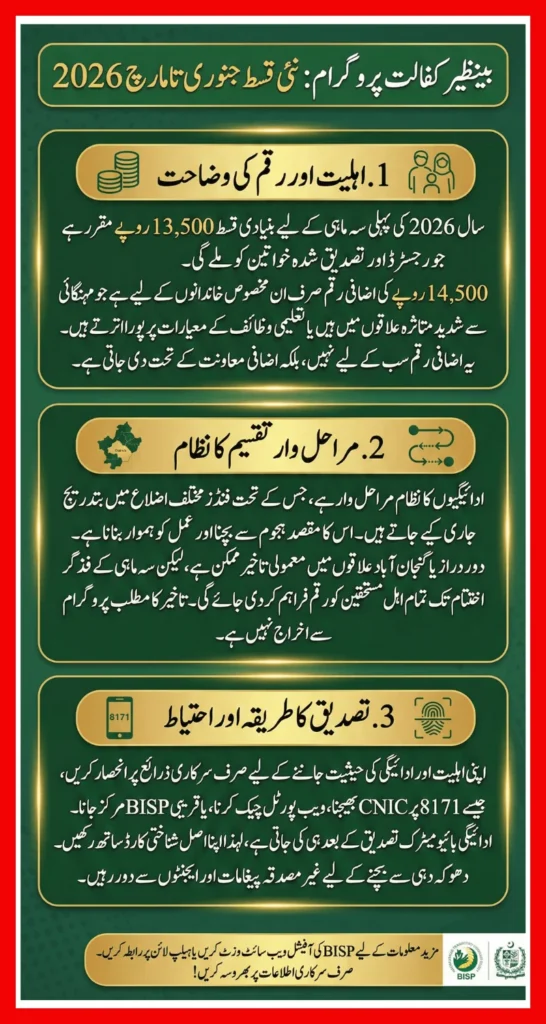
For the year 2026, the government has revised the financial assistance provided under the Benazir Kafaalat Program in response to rising inflation and increasing household expenses. The standard quarterly installment for most beneficiaries is set at 13,500 PKR. This revised amount applies to women who are already enrolled and verified under the BISP Kafaalat framework. The adjustment aims to support low-income households in meeting essential needs such as food, utilities, and basic healthcare. However, it is important to understand that 13,500 PKR is the base payment, not the maximum possible amount. Some families may receive additional financial support depending on their circumstances and enrollment in BISP-linked initiatives.
Why Some Families Receive 14,500 PKR Instead of 13,500
The 14,500 PKR payment is not a new universal installment. Instead, it represents a combined or enhanced amount given to specific beneficiaries who qualify for extra assistance. This higher payment usually results from supplementary support added to the base Kafaalat installment, rather than a blanket increase for all recipients. Many beneficiaries mistakenly assume that the government has raised the quarterly amount for everyone, which is not the case. The additional funds are provided to address special needs, regional economic pressures, or education-related support for children.
BISP 8171 January 2026 Rs. 14,500 Installment Guide Know CNIC Validation & Payment Eligibility
Eligibility Criteria for Receiving the Higher Payment
Only households that meet specific conditions recorded in the BISP system are eligible for receiving 14,500 PKR during the January 2026 cycle. These conditions are verified through official data and surveys.
You may qualify for the higher amount if:
- Your household is located in an area officially categorized as highly affected by inflation
- You are enrolled in Taleemi Wazaif with at least one child meeting attendance requirements
- School enrollment and attendance data of your children has been verified
- Your profile is marked for additional financial assistance in the BISP database
- Your household meets certain vulnerability indicators assessed through NSER data
If none of these criteria apply, you will receive the standard 13,500 PKR payment for the quarter.
Understanding Kafaalat and Taleemi Wazaif Differences
One of the main reasons for confusion around payment amounts is the misunderstanding between Kafaalat and Taleemi Wazaif programs.
- Kafaalat Program provides direct financial support to eligible women
- Taleemi Wazaif offers extra stipends for children’s school attendance
- Only families with verified school-going children qualify for Taleemi Wazaif
- Payments are added to the base amount when education criteria are met
When these two supports are combined, the total amount may increase, resulting in payments such as 14,500 PKR or more, depending on eligibility.
BISP 3rd Phase Installment 2026 Digital Payments, Bank Transfers & Free SIM Guide
January to March 2026 Payment Rollout Plan
The BISP January–March 2026 payments are being distributed through a phased district-wise system rather than all at once. This method is used every quarter to ensure smooth operations and prevent overcrowding at payment centers.
Under this rollout plan:
- Payments are released gradually by region
- Some districts receive funds earlier than others
- Remote or densely populated areas may experience short delays
- Every eligible beneficiary is covered before the quarter ends
This structured approach allows payment partners and BISP staff to manage verification processes more efficiently.
Common Reasons for Delayed Payments
Many beneficiaries worry when their payment does not arrive immediately. However, a delay does not mean removal from the program. Several routine factors can temporarily slow down disbursement.
The most common reasons include:
- Your district has not yet been included in the active payment phase
- Technical delays from banks or payment partners
- Biometric verification issues at the payment center
- Pending CNIC or fingerprint verification
- Temporary system updates or data synchronization checks
8171 BISP Result 2026 How To Check Your January Payment Eligibility Online Through Web Portal
How Beneficiaries Can Verify Their Payment Status
BISP strongly advises beneficiaries to rely only on official channels to check their payment status and avoid fraud or misinformation.
You can confirm your status through the following methods:
- Send your 13-digit CNIC number via SMS to 8171
- Check the official 8171 web portal
- Visit your nearest authorized BISP payment center
- Contact the BISP helpline for assistance
Avoid using third-party apps, agents, or social media messages, as these often provide incorrect or misleading information.
Payment Collection and Biometric Verification Process
All BISP payments are issued only after biometric verification to ensure transparency and prevent misuse of funds. Beneficiaries must bring their original CNIC when collecting payment.
If biometric verification fails, you should:
- Try verification at another authorized payment center
- Seek help from on-site BISP staff
- Visit NADRA to update fingerprints if necessary
Benazir Income Support Program Card Apply and Check Status Online
What to Expect in the Coming Weeks
As the January–March 2026 quarter progresses, more districts will continue to receive payments. Beneficiaries who are still waiting should regularly check their status through official channels. Those eligible for additional support may receive the enhanced amount once all verifications are complete. BISP continues to update its system to ensure deserving families receive timely assistance.
Final Thoughts
The BISP January–March 2026 installment is being released through a structured system based on eligibility, payment phases, and biometric verification. While most beneficiaries will receive 13,500 PKR, some households may qualify for 14,500 PKR due to additional support factors. Delays are normal under the phased rollout system. Beneficiaries should stay patient, rely only on official BISP sources, and avoid unverified social media claims.
Latest Update Benazir Mazdoor Card Online Registration 2025
FAQs
Q1: What is the BISP payment amount for January–March 2026?
Most beneficiaries receive 13,500 PKR, while selected families may get up to 14,500 PKR.
Q2: Is the 14,500 PKR payment given to all beneficiaries?
No, it is only for beneficiaries eligible for additional support such as Taleemi Wazaif.
Q3: Why are some people still waiting for their payment?
Payments are released in phases, so some districts receive installments later.
Q4: How can I check my BISP payment status?
Send your CNIC to 8171 via SMS or check through the official 8171 portal.
Q5: What is the difference between Kafaalat and Taleemi Wazaif?
Kafaalat is basic support for women, while Taleemi Wazaif is an education stipend for children.
Q6: Do I need biometric verification to receive payment?
Yes, biometric verification with original CNIC is mandatory at payment centers.
Q7: What should I do if my biometric verification fails?
Visit another payment center or update your fingerprints at NADRA.
Q8: Can payment be delayed due to system issues?
Yes, temporary technical or data verification issues may cause short delays.
Q9: Are unofficial apps safe for checking BISP payments?
No, always use official BISP channels to avoid fraud or misinformation.
Q10: Will all eligible beneficiaries receive payment by March 2026?
Yes, all verified beneficiaries are covered within the January–March payment cycle.
NSER New Registration Process Start For Benazir Kafaalat 13500