
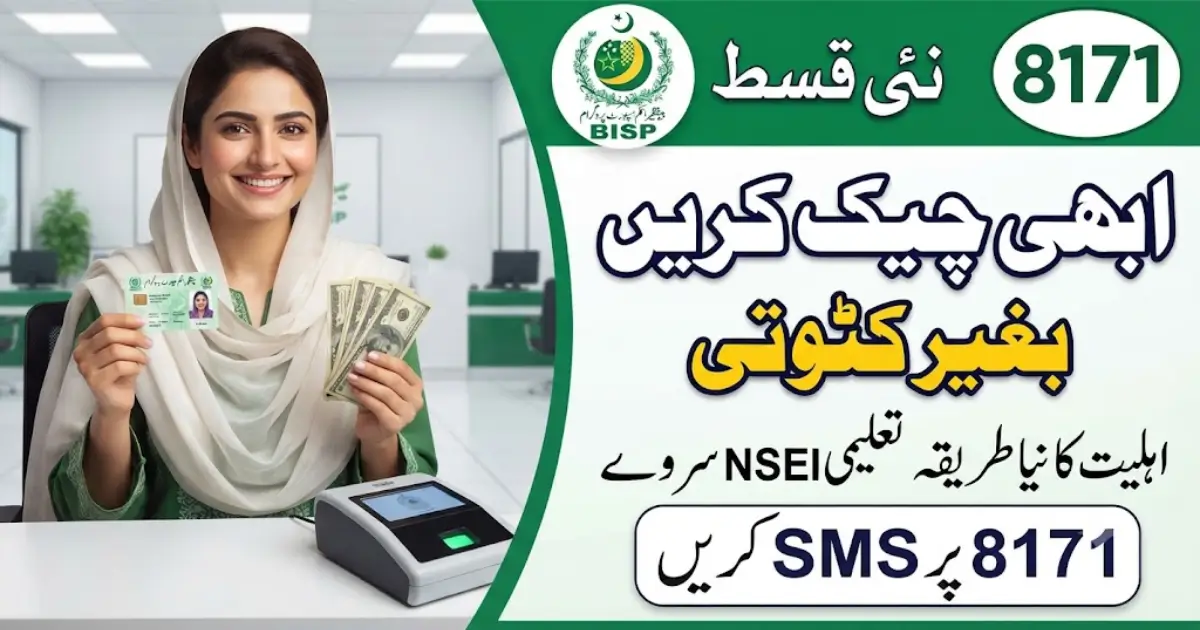
BISP 8171 August 2026 New Payment
BISP 8171 August 2026 New Payment. The Benazir Income Support Programme continues to provide financial assistance to millions of deserving families across Pakistan. Every quarter, eligible women receive cash support to help manage household expenses, children’s education, and other basic needs. With rising inflation, these payments remain an important source of financial relief for low-income households.
For August 2026, BISP has introduced several important updates to improve transparency, reduce fraud, and make the payment process easier for beneficiaries. These changes include stronger digital payment systems, stricter verification procedures, updated Dynamic NSER surveys, and improved monitoring of payment centers.
If you are already receiving BISP payments or planning to become a beneficiary, this complete guide explains everything you need to know about the latest payment update, eligibility rules, registration process, required documents, payment collection methods, and official instructions.
Sindh Youth Card 2026 Registration Online Complete Guide for 100000 Young People
Quick Overview of BISP August 2026 Payment Update
| Program | Details |
|---|---|
| Program Name | Benazir Income Support Programme (BISP) |
| Payment Cycle | August 2026 Quarterly Installment |
| Main Payment | Rs. 13,500 to Rs. 14,500 |
| Educational Support | Benazir Taleemi Wazaif |
| Health Support | Benazir Nashonuma |
| Payment Methods | Campsites, Partner Banks, ATMs, Authorized Agents |
| Verification | Dynamic NSER Survey & Biometric Verification |
| Official SMS Service | 8171 |
| Eligibility Check | Through CNIC |
| Registration Fee | Completely Free |
What is the BISP August 2026 New Payment Update?
The Benazir Income Support Programme is Pakistan’s largest social welfare initiative designed to support financially vulnerable families. The program provides quarterly cash assistance to eligible women so they can meet daily household expenses.
For the August 2026 payment cycle, BISP has focused on making the payment system more secure and transparent. The government has strengthened digital payment channels, increased monitoring of payment centers, and introduced new verification measures to ensure that financial assistance reaches only deserving beneficiaries.
These improvements are also intended to reduce delays, prevent illegal deductions, and make the payment process simpler for women across all provinces, including Punjab, Sindh, Khyber Pakhtunkhwa, Balochistan, Gilgit-Baltistan, and Azad Jammu & Kashmir.
Major Changes Introduced in BISP August 2026
Digital Payment System Expansion
BISP is gradually replacing traditional payment methods with secure digital payment systems. More beneficiaries are receiving payments through bank accounts and SIM-linked digital services to improve security and transparency.
Strict Action Against Illegal Deductions
Many beneficiaries previously reported unauthorized deductions made by payment agents.
To stop this practice, BISP has introduced:
- Strict inspections
- Complaint monitoring teams
- Immediate action against dishonest agents
- Blacklisting of violators
Women should always receive the complete payment without paying any commission.
Dynamic NSER Survey Becomes More Important
Families that registered several years ago are now required to update their household information through the Dynamic NSER Survey.
Failure to update records may temporarily stop future payments until verification is completed.
Mandatory NADRA B-Form Verification
Families receiving Benazir Taleemi Wazaif must ensure that every child’s B-Form is properly verified through NADRA.
Children must also continue attending school regularly.
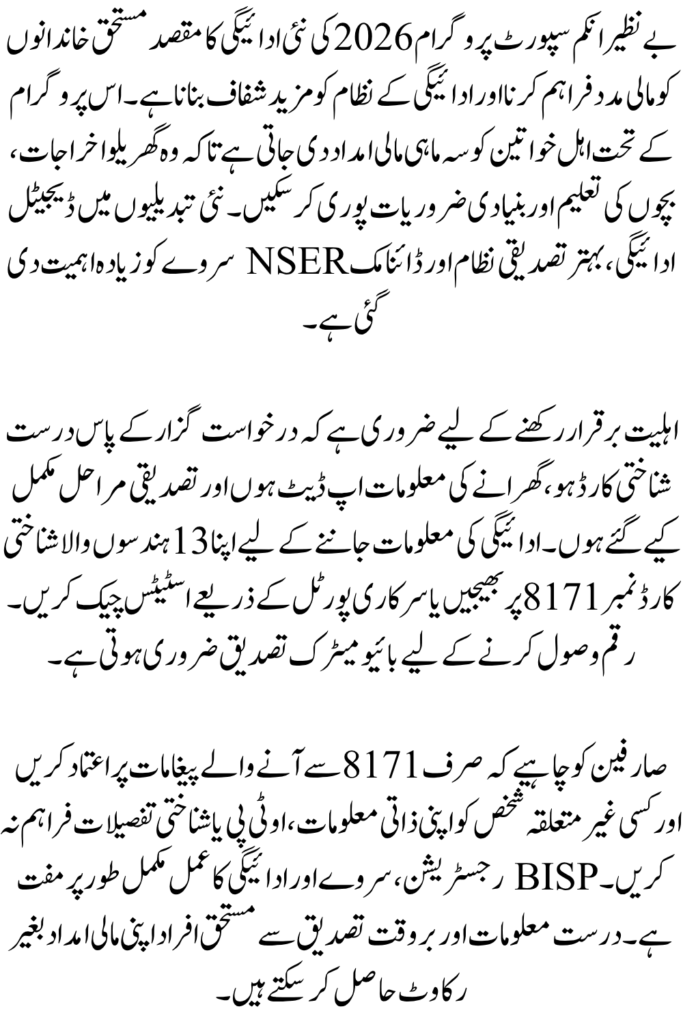
Official SMS Alerts Only Through 8171
All payment updates, eligibility information, and verification messages are sent only through the official 8171 service.
Beneficiaries should ignore messages received from personal mobile numbers pretending to represent BISP.
Eligibility Criteria for BISP August 2026 Payment
Applicants must fulfill the official eligibility requirements before receiving financial assistance.
Female Head of Household
The applicant should be:
- Married woman
- Widow
- Divorced woman
She must possess a valid computerized CNIC issued by NADRA.
Low Poverty Score
The household should qualify according to the government’s Poverty Means Test (PMT) score.
Families with higher income levels may not qualify.
No Government Employment
Neither the applicant nor her husband should be a permanent employee of:
- Federal Government
- Provincial Government
- Semi-Government Organizations
Regular pensioners are generally not eligible.
Asset Verification
Eligible families should not own valuable commercial property, large agricultural land, or expensive assets that indicate financial stability.
Travel History
Applicants with frequent international travel records (except religious pilgrimages) may become ineligible after verification.
Benefits of BISP August 2026
Eligible families receive several types of assistance through different BISP programs.
Quarterly Cash Assistance
Women receive quarterly financial support ranging between:
Rs. 13,500 to Rs. 14,500
This amount helps families manage:
- Food expenses
- Utility bills
- Medicine
- Household needs
Benazir Taleemi Wazaif
Additional educational stipends encourage parents to continue their children’s education.
Different stipend amounts are available for:
| Education Level | Boys | Girls |
|---|---|---|
| Primary | Rs. 1,500 | Rs. 2,000 |
| Secondary | Rs. 2,500 | Rs. 3,000 |
| Higher Secondary | Rs. 3,500 | Rs. 4,000 |
Girls receive slightly higher stipends to encourage female education.
Benazir Nashonuma
Pregnant women, breastfeeding mothers, and young children can receive additional conditional financial assistance under the Nashonuma Program.
Transparent Payment System
Improved monitoring ensures beneficiaries receive the complete payment without illegal deductions.
Required Documents
Applicants should keep the following documents ready during verification or registration.
| Required Document | Purpose |
|---|---|
| Original CNIC | Identity Verification |
| Registered Mobile Number | SMS Notifications |
| Children’s NADRA B-Forms | Taleemi Wazaif Verification |
| School Enrollment Record | Student Verification |
| Dynamic NSER Survey Information | Household Verification |
| Biometric Verification | Payment Collection |
Always carry original documents when visiting a BISP office or payment center.
Registration and Apply Method Step by Step
Step 1 – Visit Your Nearest BISP Tehsil Office
Applicants who have not completed the latest Dynamic NSER Survey should visit their nearest BISP Tehsil Office.
Step 2 – Bring Original Documents
Carry your:
- Original CNIC
- Children’s B-Forms (if applicable)
- Registered mobile number
These documents help officials verify your information.
Step 3 – Complete the Dynamic NSER Survey
Provide updated household information, including:
- Family members
- Income
- Employment details
- Residence
- Household conditions
The survey determines your latest eligibility.
Step 4 – Wait for Verification
BISP officials verify the submitted information using government databases.
Verification may take some time depending on your district.
Step 5 – Receive Confirmation
Eligible applicants receive confirmation through the official 8171 SMS service.
Only trust messages sent from 8171.
Step 6 – Collect Your Payment
After payment approval, beneficiaries can collect funds through:
- Official BISP Campsites
- Partner Bank ATMs
- Authorized Payment Centers
- Approved Retail Agents (where available)
Biometric verification is required before payment.
How to Check BISP August 2026 Payment Status
Method 1 – Through 8171 SMS
Checking your payment through SMS is simple.
Follow these steps:
- Open your phone’s messaging app.
- Type your 13-digit CNIC number.
- Send it to 8171.
- Wait for the official reply.
The response will tell you whether:
- Payment has been released.
- Verification is pending.
- Additional documents are required.
Method 2 – Through the 8171 Web Portal
Beneficiaries can also check payment status online.
Steps include:
- Visit the official 8171 portal.
- Enter your CNIC number.
- Complete the captcha.
- Click Check Status.
The portal displays your latest eligibility and payment details.
Selection Process
BISP follows a structured selection process to identify deserving families.
Household Survey
The Dynamic NSER Survey collects updated household information.
Data Verification
Government databases verify:
- CNIC records
- Income
- Family information
- Household conditions
PMT Score Evaluation
The household’s Poverty Means Test score is calculated.
Only eligible families move to the next stage.
Final Approval
After successful verification, approved applicants begin receiving quarterly payments.
Important Instructions for Beneficiaries
Registration is Completely Free
No fee is charged for:
- Registration
- Dynamic Survey
- Verification
- Payment Collection
Anyone demanding money is committing fraud.
Never Share Personal Information
Do not provide:
- CNIC copies
- OTP codes
- Bank details
- Passwords
Only deal with official BISP representatives.
Keep Your Mobile Number Active
Ensure your SIM remains active and registered under your CNIC.
This helps you receive important payment notifications.
Update Household Information
Whenever family details change, visit your nearest BISP office to update your records.
Keeping information current helps prevent payment interruptions.
Complete Biometric Verification
Payments are released only after successful biometric verification.
If fingerprint verification fails, request assistance from the payment center staff.
Final Thoughts
The BISP August 2026 New Payment Update introduces several important improvements aimed at making financial assistance more transparent, secure, and accessible for deserving families. Stronger digital payment systems, updated Dynamic NSER surveys, improved biometric verification, and strict action against illegal deductions will help ensure that beneficiaries receive their full payments without unnecessary delays.
Eligible families should keep their household information updated, complete all required verifications, and rely only on official 8171 communications for payment updates. By following the official procedures and maintaining accurate records, beneficiaries can continue receiving quarterly assistance smoothly while also benefiting from educational and health support programs offered under BISP.
New Updates Benazir Kafaalat Program Again Distribute Double Installment 2026
Frequently Asked Questions
1. What is the BISP August 2026 payment amount?
Eligible beneficiaries can receive quarterly assistance ranging from Rs. 13,500 to Rs. 14,500, depending on their program status.
2. How can I check my payment?
You can check your payment through:
- SMS by sending your CNIC to 8171
- The official 8171 online portal
3. Is registration free?
Yes. BISP registration, surveys, and payment collection are completely free.
4. Who can receive Benazir Taleemi Wazaif?
Children of active Benazir Kafaalat beneficiaries who meet the education and attendance requirements.
5. What happens if my Dynamic NSER Survey is not updated?
Your payment may be temporarily stopped until your household information is updated.
6. Can I receive payment without biometric verification?
Normally, biometric verification is required. If fingerprints cannot be verified, follow the official verification procedure available at the payment center.
7. Which SMS number is officially used by BISP?
Only 8171 sends official BISP payment and eligibility messages.
8. What should I do if an agent deducts money from my payment?
Immediately report the issue to the complaint desk available at the payment center or BISP office and keep your payment receipt as proof.
9. Are educational stipends available separately?
Yes. Eligible children enrolled under Benazir Taleemi Wazaif receive separate educational stipends according to their education level.
10. Which documents are required for registration?
Generally, applicants should have their original CNIC, registered mobile number, children’s B-Forms (if applicable), and updated household information for the Dynamic NSER Survey.